Surface Finishes

Precision CNC Machining Services

Powder coating is a dry finishing process commonly used to apply a durable and protective finish to a variety of surfaces, primarily metal.

All your designs are secure and confidential

Powder Coating

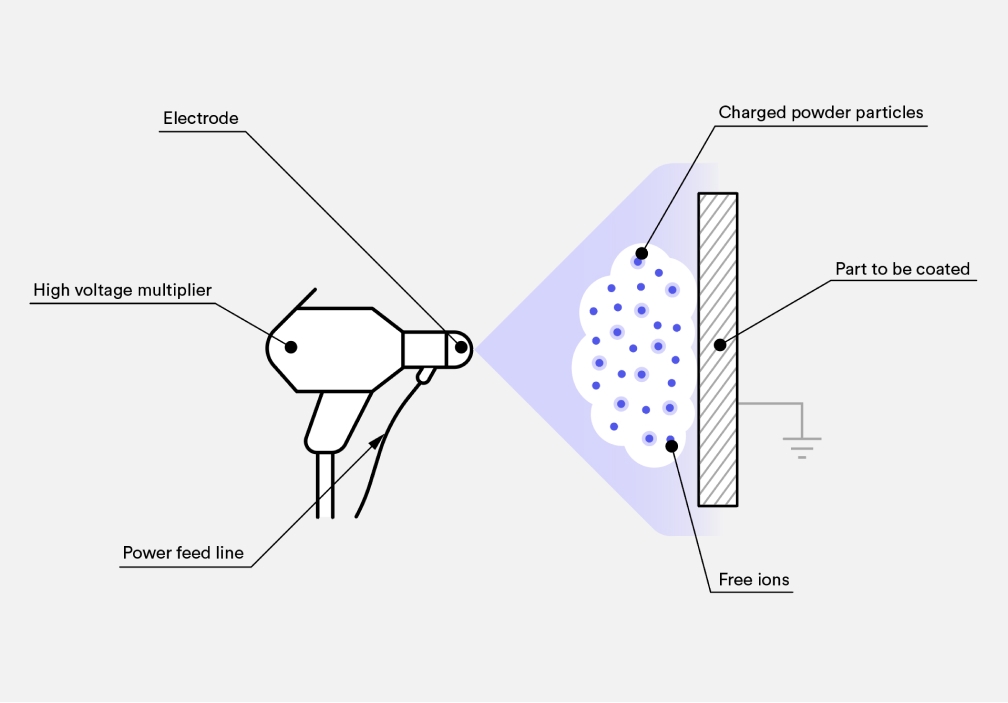
Powder coating is a procedure in which a completely dry powder paint (either a polycarbonate or thermoset polymer) is put on a metal surface area making use of electrostatic application. Unlike conventional fluid paint, powder finish does not need a solvent to keep the binder and filler of the paint in liquid suspension. This enables the application of thicker finishings without running or drooping, and the coverings are tougher.

Applicable MaterialsSurface PreparationColorsGlossinessSurface TextureCosmetic AvailabilityThicknessVisual Appearance
MetalsAs machined (Ra 1.6μm)White, Black, and PantoneGlossy/MatteFlat/TextureOn request50μm to 300μmParts are powder coated directly after machining.
 

As Machined Parts

11-6

Aluminum CNC

1-15

Aluminum CNC

48-1

UHMWPE CNC

14-6

UHMWPE CNC

Nickel CNC Machining Gallery

Powder Coating Process

Powder finish is a strong, wear-resistant surface finish that is compatible with all steel products. Here’s how to apply powder coating: Clean parts to remove inorganic contaminants To enhance performance and quality, pretreat parts with a conversion coating Rinse and dry parts in an oven Mask critical areas to prevent tolerance issues Coat parts with an electrostatic spray gun Dry parts in an oven to cure the coating

right3

As Machined Design Considerations

Choose Machinable Materials: Select materials known for their machinability and surfacefinish characteristics.
Simplify Geometry: Design parts with accessible features, avoiding complex shapes and tight tolerances.
Optimize Tools and Toolpaths: Use sharp tools, reduce vibrations, and select toolpaths that minimize tool engagement.

FAQs

The two primary CNC machining processes are CNC turning and CNC milling. Other machining processes include drilling, gear hobbing and electrical discharge machining,grinding among others.

Parts machined with metal will follow ISO 2768-m (medium) or ISO 2768-f (fine). Parts machined with plastics will follow 2768-m (medium). Geometric tolerances down to ± 0.001mm are possible but must be clearly indicated in technical drawings. We can achieve tighter tolerances on shafts with up to H7 fits with manual quoting and on occasion tighter.

We offer CNC milling (3-axis, 3+2-axis and 5-axis) and turning. Milled parts can be machined up to 2000 x 1500 x 300 mm for 3, 3+2 axis CNC milling. For 5-axis milling, the maximum part size is 650 x 650 x 300 mm. The maximum diameter for CNC turning is 431mm, length 990 mm. Minimum part dimensions recommended are around 2 x 2 x 2mm.The minimum for feature dimensions is 0.5 mm.

Deburing and edge breaking are standard procedures for all CNC machined parts. lf there are any critical edges that should be left sharp, they must be clearly indicated in technical drawings. Surfaces will be free of defects such as scratches, dents, stains, blemishes, hanging marks, minor defects. Surfaces indicated ascritical (primary (a) side, as indicated on the technical drawing) will be free of mill steps and other marks. For the secondary (b) side, minor hanging marks and up to 2 minor defects are acceptable. A number of post-processing and finishing methods can be applied to improve the surface roug hness, visual properties andwear resistance of machined parts.

We offer UNF, UNC, and metric threads for machining along with coil and key inserts. These are available on both milled or turned CNC parts.

Let's get your projects started, together.